
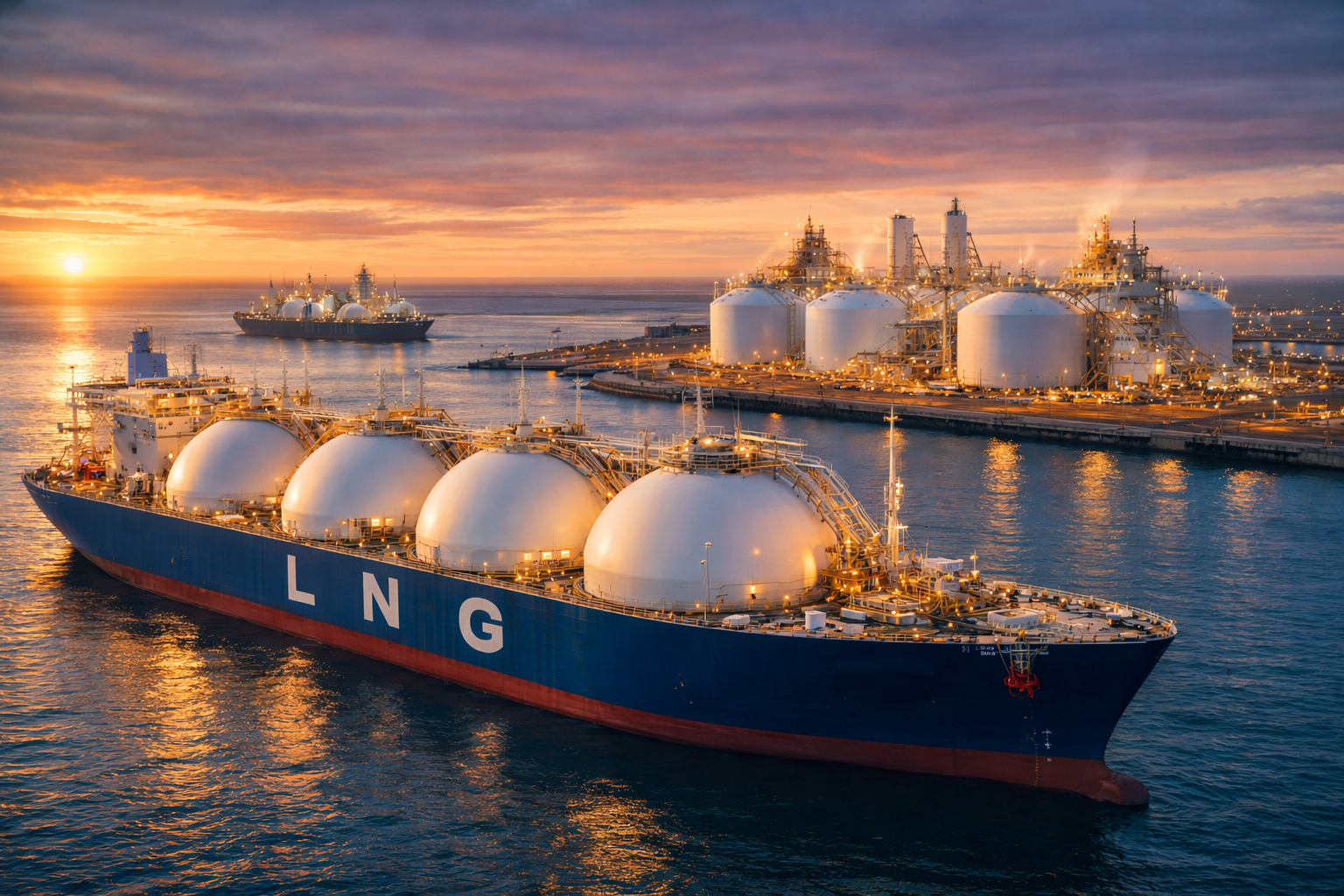
The Liquified Natural Gas Price Trend in Q3 2025 showed a mix of stability and pressure across major exporting countries. During this period, the global LNG market moved in a careful balance between supply growth and moderate demand. While production capacity continued to expand in many regions, demand from key importing countries remained uneven. As a result, prices moved differently across Australia, the United States, and Qatar.
Globally, LNG demand grew at a moderate pace. However, the increase was not strong enough to create supply shortages. Many Asian countries, especially China and India, reduced their spot purchases due to economic uncertainty and relatively higher prices earlier in the year. At the same time, Europe continued to import large volumes of LNG to compensate for reduced pipeline gas supplies. This created an interesting situation where Europe showed strong import activity, but Asia displayed softer buying interest.
Price volatility remained present throughout the quarter. Geopolitical tensions and changing supply-demand patterns made traders cautious. Buyers were more selective, and sellers had to adjust their offers to stay competitive. This environment shaped the overall Liquified Natural Gas Prices during Q3 2025.
Australia LNG Price Trend
Australia is one of the world’s leading LNG exporters. In Q3 2025, LNG export prices from FOB Port Darwin (Methane Content ≥ 90%) experienced a moderate decline of 4.54%. Prices ranged between USD 14.98 and USD 18.21 per metric ton during the quarter.
Please Submit Your Query For Liquified Natural Gas Price Trend, Market Analysis and Forecast: https://www.price-watch.ai/book-a-demo/
The Liquified Natural Gas Price Trend in Australia reflected the impact of rising global liquefaction capacity and softer Asian demand. As new projects increased supply in the global market, competition among exporters intensified. Since Asia is a major buyer of Australian LNG, the reduced demand from China and India directly affected pricing levels.
Buyers adopted a cautious approach during the quarter. Some companies delayed fresh cargo purchases, waiting for better price opportunities. Additionally, the global energy transition toward cleaner fuels and renewable energy sources also influenced long-term buying decisions. This made procurement teams more careful in committing to new LNG shipments.
In September 2025, prices in Australia declined further by 9.35%. This sharper drop toward the end of the quarter highlighted stronger pricing pressure. Even though upstream production remained stable, shipping volumes were slightly lower, and new suppliers entered regional markets. Sellers had to reduce offer prices to maintain competitiveness. Overall, the Liquified Natural Gas Price Trend in Australia showed a clear downward movement during Q3 2025.
United States LNG Price Trend
The United States also witnessed price adjustments in Q3 2025. LNG export prices from Ex-Louisiana (Methane Content ≥ 90%) recorded a notable quarterly decline of 6.71%. Prices ranged between USD 2.82 and USD 3.53 per metric ton.
The Liquified Natural Gas Price Trend in the United States was mainly influenced by oversupply conditions and weaker overseas demand. The country continued expanding its LNG infrastructure, which supported higher production and export capacity. However, global demand did not rise at the same pace. This led to growing inventories and added downward pressure on prices.
Another important factor was the competitive nature of pipeline gas supplies in Europe and Asia. In some cases, pipeline gas became more price-attractive compared to LNG cargoes. This reduced spot demand for U.S. LNG exports.
Despite the overall quarterly decline, September 2025 showed a small recovery. LNG prices increased by 2.05% during the month. This minor rebound suggested that buyers were taking advantage of earlier price dips. The pricing structure linked to Henry Hub natural gas benchmarks also played a role in shaping trends. Since domestic gas prices remained relatively balanced, export prices followed a controlled pattern.
However, trading activity remained cautious. Enquiries from international buyers were steady but not aggressive. This indicated that the market was well supplied, and buyers did not feel urgent pressure to secure additional volumes. Overall, the Liquified Natural Gas Price Trend in the United States during Q3 2025 reflected a generally soft but stable market environment.
Qatar LNG Price Trend
Qatar, known for its strong long-term LNG supply contracts, experienced relatively stable pricing during Q3 2025. LNG export prices from FOB Ras Laffan (Methane Content ≥ 90%) recorded only a marginal decrease of 0.20%. Offers ranged between USD 10.3 and USD 12.29 per metric ton.
The Liquified Natural Gas Price Trend in Qatar remained steady because of its long-term contractual commitments. Unlike spot-driven markets, Qatar’s export model provides stability through fixed agreements with major buyers. This reduces exposure to short-term price swings.
Although spot enquiries from Asia and Europe fluctuated slightly, overall export volumes remained consistent. Qatar’s strong production base and established global relationships helped maintain price balance. Even when global markets faced volatility, the country’s pricing trend showed limited movement.
This stability highlights the importance of contract structure in LNG markets. Countries with higher spot market exposure may experience stronger price fluctuations, while exporters with long-term contracts often see more controlled price changes.
Global Market Sentiment in Q3 2025
Looking at the broader picture, the global Liquified Natural Gas Price Trend during Q3 2025 can be described as cautious and balanced. Supply growth continued across major exporting countries, while demand remained moderate. Asia showed softness, Europe remained active, and new suppliers increased competitive pressure.
Geopolitical factors also influenced market sentiment. Traders kept a close watch on international developments that could affect supply routes or energy policies. Even minor disruptions or policy announcements were enough to influence short-term price movements.
Another key factor was the energy transition movement worldwide. Many countries are gradually shifting toward renewable energy sources. While LNG is considered a cleaner fossil fuel compared to coal and oil, long-term policy goals still influence procurement strategies. This adds a layer of uncertainty to future demand growth.
Freight rates and shipping availability also played a role. Although production remained steady, lower shipping volumes in some regions limited cargo movements. This indirectly affected price negotiations between buyers and sellers.
Conclusion
In summary, the Liquified Natural Gas Price Trend in Q3 2025 reflected a market adjusting to balanced supply and moderate demand. Australia and the United States experienced noticeable price declines due to oversupply and softer Asian demand. Qatar, supported by long-term contracts, maintained relatively stable pricing.
September 2025 showed mixed signals. Australia faced sharper declines, the United States saw a minor rebound, and Qatar remained steady. These variations highlight how regional factors, contract structures, and demand patterns shape pricing outcomes.
Overall, the market remained resilient despite volatility. Buyers were cautious, sellers stayed competitive, and global trade flows continued without major disruptions. As the world continues to transition toward cleaner energy systems, the Liquified Natural Gas Price Trend will remain influenced by economic conditions, geopolitical developments, and long-term energy policies.
The coming quarters will likely depend on winter demand patterns, global economic recovery, and future supply expansions. For now, Q3 2025 stands as a period of moderate softness, controlled supply growth, and careful trading behavior in the global LNG market.
About Price Watch™ AI
Price-Watch AI is an India-based, independent raw material price reporting agency that provides real-time price forecasts and data-driven insights into global raw material markets. Price-Watch AI specializes in tracking raw material prices, analyzing market trends, and delivering timely updates on plant shutdowns, supply disruptions, capacity expansions, and demand-supply dynamics. The Price-Watch AI platform empowers manufacturers, traders, and procurement professionals to make faster, smarter decisions. Leveraging AI-powered forecasting and over a decade of historical data, Price-Watch AI transforms market volatility into actionable opportunity.
Futura Tech Park, C Block, 8th floor 334, Old Mahabalipuram Road, Sholinganallur, Chennai, Tamil Nadu, Pincode - 600119.
𝐋𝐢𝐧𝐤𝐞𝐝𝐈𝐧: https://www.linkedin.com/company/price-watch-ai/
𝐅𝐚𝐜𝐞𝐛𝐨𝐨𝐤:https://www.facebook.com/people//61568490385598/
𝐓𝐰𝐢𝐭𝐭𝐞𝐫: https://x.com/pricewatchai
𝐖𝐞𝐛𝐬𝐢𝐭𝐞: :https://www.price-watch.ai/